
Search This Supplers Products:power bankmobile phone batterymobile Chargermobile Cable
IATA Issues 67th Edition Addendum for Dangerous Goods Regulations Affecting Battery Shipments
time2026/03/13
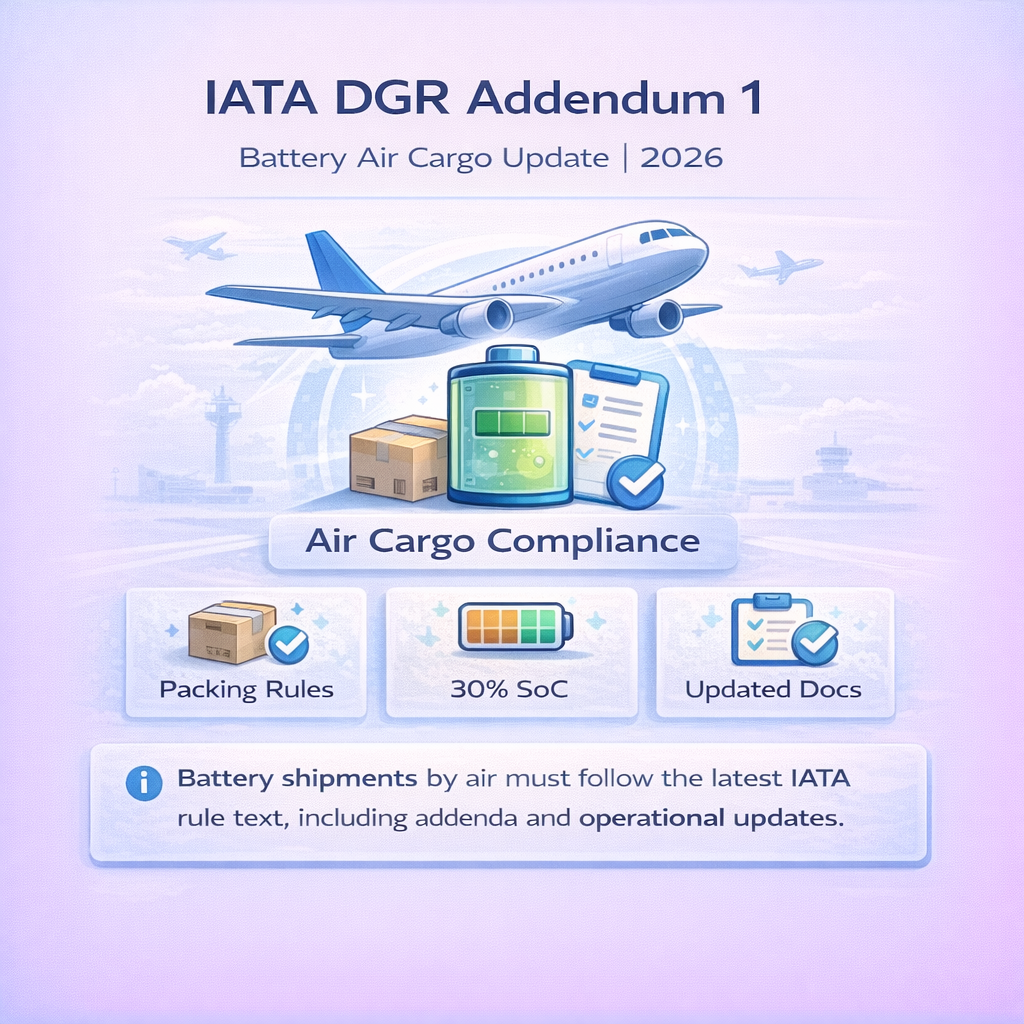
- On 1 January 2026, IATA issued Addendum 1 to the 67th Edition of the Dangerous Goods Regulations, reinforcing updated battery air cargo compliance requirements. The addendum matters because lithium battery shipments must follow the latest rule language on packing instructions, documentation, UN 38.3 testing, and the expanded 30% state-of-charge restrictions affecting certain batteries packed with equipment.
IATA Issues 67th Edition Addendum for Dangerous Goods Regulations Affecting Battery Shipments
On 1 January 2026, IATA posted Addendum 1 to the 67th Edition of the Dangerous Goods Regulations (DGR), introducing amendments and corrections effective from the same date. The update is directly relevant to companies involved in lithium battery logistics, battery packs, and portable power product shipments by air.
For battery exporters, the practical importance of the addendum is clear: air cargo compliance depends not only on the main DGR edition, but also on later corrections, clarifications, and operational updates issued by IATA.
Framework: IATA Dangerous Goods Regulations, 67th Edition
Update type: Addendum 1
Effective date: 1 January 2026
Main relevance: Lithium battery air cargo compliance, packing instructions, documentation, and state-of-charge limits
Why the Addendum Matters
The 2026 DGR framework already included battery-related changes, but the addendum matters because operators must apply the most current rule language in actual shipping practice. For lithium cells and batteries transported by air, compliance is tied to packaging, labels, documentation, UN 38.3 testing status, and any later IATA operational clarifications.
The base framework defines dangerous goods shipping rules for 2026 air transport operations.
Corrections and clarifications may affect how battery shipments are handled in practice.
Shippers, forwarders, and airlines must align actual export procedures with the updated text.
State of Charge Rules Remain a Key Issue
One of the most important battery-shipment themes in the 2026 rules is the stricter treatment of state-of-charge (SoC) limits for certain lithium-ion batteries. IATA materials explain that the 30% SoC restriction that previously applied to PI 965 was extended into PI 966, becoming mandatory in 2026 for lithium-ion batteries packed with equipment above the specified threshold.
- Confirm whether the shipment falls under the applicable packing instruction threshold.
- Check whether lithium-ion batteries packed with equipment must remain at 30% SoC or below.
- Review whether additional approval conditions apply if batteries are offered above 30% SoC.
What Exporters Need to Check in Practice
For shippers, freight forwarders, and airlines, battery transport compliance in 2026 is not only about packaging and labels. Teams must also verify the correct packing instruction, charge condition, documentation path, and whether any state approval is required.
| Compliance Area | Why It Matters |
|---|---|
| Packing Instruction | Different lithium battery shipment types follow different handling and documentation rules |
| State of Charge | Some lithium-ion shipments must meet the 30% SoC limit |
| UN 38.3 Status | Air transport requires that cells and batteries meet the applicable testing requirements |
| Documentation Path | Operators must confirm whether any declarations, approvals, or updated procedures apply |
Why Portable Power Exporters Should Pay Attention
Portable battery products, battery packs, and related electronic accessories shipped by air may face tighter review if internal compliance teams do not keep up with the latest DGR language and addendum updates. This is especially important for companies shipping lithium-ion batteries, batteries packed with equipment, or portable power products through international air cargo channels.
May face stricter charge-condition and documentation review.
Need accurate classification, testing proof, and shipment control.
Packing method and battery condition may affect air shipment acceptance.
Conclusion
The 67th Edition Addendum reinforces that battery air cargo compliance in 2026 depends on close attention to current IATA rule text, not just older operational habits. For exporters and logistics teams, keeping up with DGR addenda is essential to reduce shipment risk and maintain smooth international air transport for battery products.