
Search This Supplers Products:power bankmobile phone batterymobile Chargermobile Cable
IATA Reaffirms Carry-On-Only Rules for Power Banks as Spare Lithium Batteries
time2026/03/20
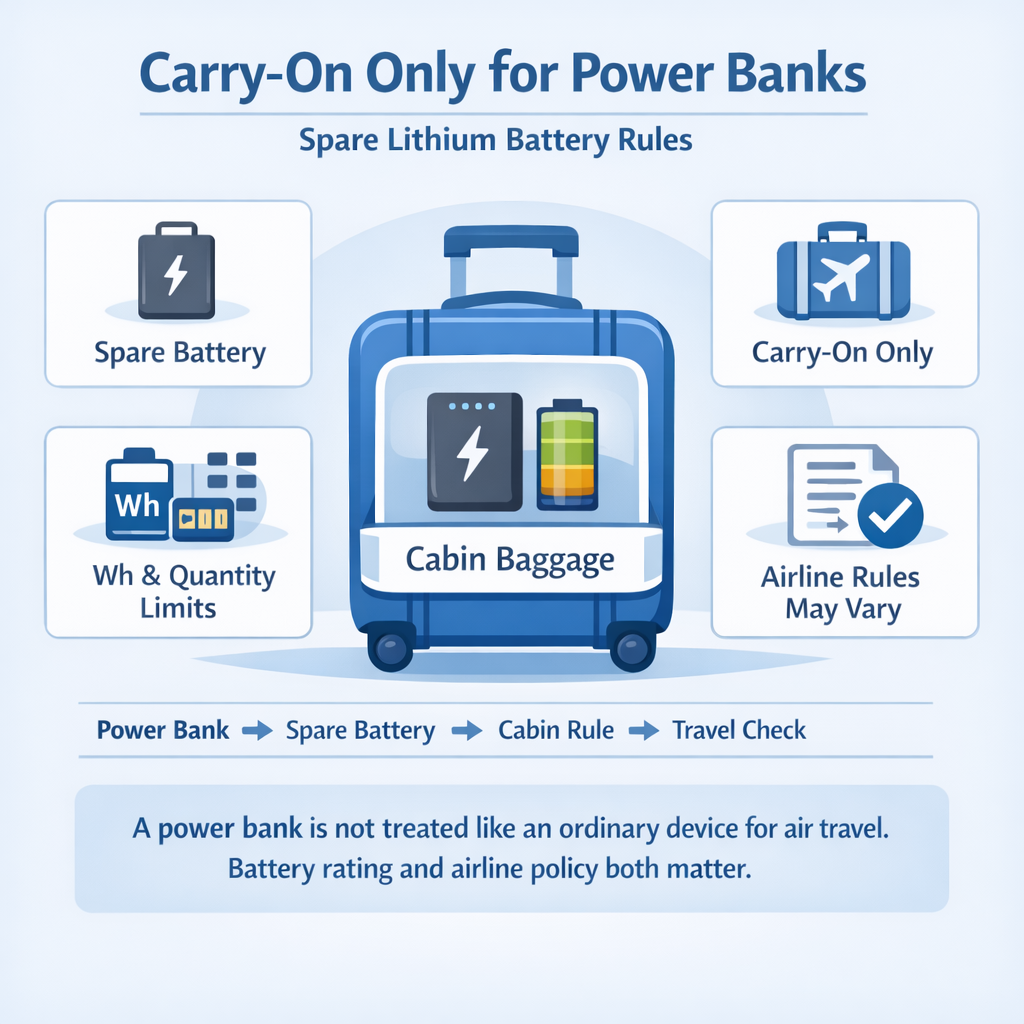
- IATA continues to reaffirm that power banks are treated as spare lithium batteries, not ordinary travel electronics. As a result, they must be carried in cabin baggage, remain subject to watt-hour and quantity limits, and may face additional airline-specific restrictions, making battery classification and safe handling important parts of air travel preparation.
IATA Reaffirms Carry-On-Only Rules for Power Banks as Spare Lithium Batteries
In 2026, IATA continued to reaffirm a key travel rule that many passengers still misunderstand: power banks are treated as spare lithium batteries, not as ordinary consumer electronics.
Because of that classification, they must be carried in cabin baggage only and must not be placed in checked baggage.
Topic: Passenger rules for power banks and spare lithium batteries
Core rule: Carry-on only, not checked baggage
Why it matters: Power banks are classified as spare lithium batteries
Power Banks Are Not Treated Like Ordinary Electronics
One of the most common passenger misunderstandings is assuming that a power bank can be handled like a phone, tablet, or laptop simply because it is a portable electronic product.
Under aviation safety rules, however, a power bank belongs to the spare battery category. That changes how it must be packed, carried, and assessed for travel.
Why Cabin Baggage Only Still Matters
IATA guidance continues to make clear that spare lithium batteries must remain in cabin baggage rather than checked baggage. The underlying reason is operational safety: if a lithium battery incident occurs in the cabin, it is easier for crew to detect and respond to it than if it occurs in the aircraft hold.
- Battery incidents are easier to identify in the cabin
- Crew can respond more quickly if a thermal event occurs
- Loose spare batteries create greater concern than batteries installed in equipment
Wh Rating, Quantity, and Airline Policy Can Change the Outcome
Carrying permission is not based on product type alone. A power bank’s watt-hour rating, the number of units carried, and the airline’s own operating policy can all affect whether it is freely accepted, accepted only with approval, or restricted.
This is why two power banks that look similar may not be treated in the same way under air travel rules.
| Factor | Why It Affects Travel Permission |
|---|---|
| Wh Rating | Higher battery energy may trigger stricter limits or approval requirements |
| Quantity Carried | Multiple units can change whether the airline accepts them without questions |
| Airline Policy | Carriers may apply conditions beyond the general IATA guidance |
| Battery Classification | Spare batteries are subject to closer control than ordinary electronics |
Short-Circuit Protection Is Part of Safe Travel
Another important compliance point is that spare batteries should be protected against short circuit during transport. In practical travel terms, this means passengers should pay attention to terminal protection, storage method, and how the power bank is packed inside carry-on baggage.
Why This Matters for Travelers and Brands
For travelers, the carry-on-only rule sounds simple, but its real effect is broader: battery rating, classification, and airline policy all matter before departure.
For power bank brands, the same rule increases the importance of clear battery rating disclosure, travel guidance, and customer education. Product labeling and support information are becoming more valuable as aviation battery rules receive more public attention.
- Show battery rating clearly
- Explain that power banks are spare batteries for travel purposes
- Help users understand carry-on-only rules
- Provide travel-safe handling guidance
Conclusion
IATA’s continued reaffirmation of the carry-on-only rule shows that power banks are not handled like ordinary travel electronics. They are regulated as spare lithium batteries, which means closer attention to cabin carriage, Wh limits, quantity rules, and safe handling during transport.
As more travelers rely on power banks, this once-overlooked aviation rule is becoming a more visible and more practical part of everyday travel preparation.