
Search This Supplers Products:power bankmobile phone batterymobile Chargermobile Cable
USB-IF Publishes Q2 2026 USB Power Delivery Compliance Test Specification
time2026/03/23
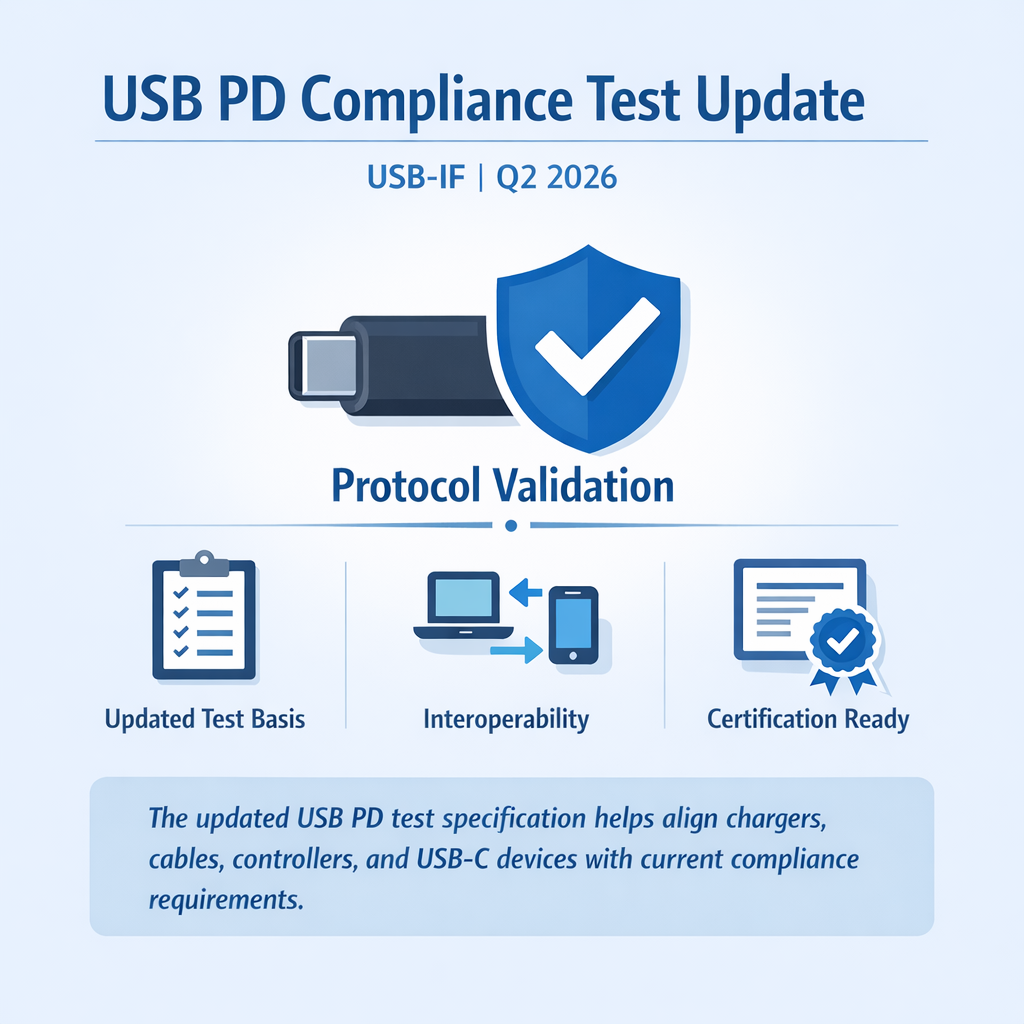
- On March 9, 2026, USB-IF published the Q2 2026 USB Power Delivery Compliance Test Specification, updating the official test basis for USB PD products. The update matters for chargers, cables, controllers, and USB-C devices because it strengthens the framework for protocol validation, interoperability, and certification readiness across the fast-charging ecosystem.
USB-IF Publishes Q2 2026 USB Power Delivery Compliance Test Specification
On March 9, 2026, USB-IF published the Q2 2026 USB Power Delivery Compliance Test Specification, updating the formal test basis used to evaluate whether USB Power Delivery products meet current compliance requirements.
The document sits within USB-IF’s official compliance framework for USB PD products and is directly relevant to chargers, cables, controllers, and end devices built around USB-C fast charging.
Topic: Q2 2026 USB Power Delivery Compliance Test Specification
Scope: Chargers, cables, controllers, and USB-C end devices
Why it matters: Protocol validation, interoperability, and certification readiness
Why the Updated Test Specification Matters
In the USB-C ecosystem, a compliance test specification defines how products are validated for protocol behavior, power negotiation, and interoperability. When USB-IF updates that specification, manufacturers and test labs need to align with the new version to ensure products are evaluated against the latest official criteria.
What the Update Can Influence in Practice
This kind of update affects more than paperwork. It can influence how engineers validate firmware behavior, how test laboratories structure procedures, and how brands prepare products for certification and cross-device compatibility.
| Area | Practical Impact |
|---|---|
| Engineering Validation | Teams may need to retune protocol behavior and update test workflows. |
| Lab Procedures | Testing labs need to align with the latest published USB-IF criteria. |
| Certification Preparation | Brands must ensure products are ready for the newest compliance expectations. |
| Cross-Device Compatibility | More standardized testing can reduce interoperability problems in the market. |
Why This Matters for USB-C Charging Products
USB Power Delivery is now a core charging standard across smartphones, tablets, laptops, docks, power banks, and many accessories. Because of that, even a technical document update can have wider market influence.
For chargers, cables, and portable power products, the updated specification reinforces that performance is not only about headline wattage. Real compliance depends on whether a product negotiates voltage and current correctly, responds properly to protocol messages, and behaves consistently under defined test conditions.
- USB-C chargers and adapters
- Fast charging cables
- USB PD controllers and related components
- Power banks supporting USB Power Delivery
- Phones, tablets, laptops, and other USB-C end devices
A Stronger Compliance Basis for the USB-C Ecosystem
As USB-C adoption continues to expand, buyers increasingly expect products from different brands to work together smoothly. A stronger and more current compliance basis helps support user trust, better interoperability, and a more standardized fast-charging experience.
From an industry perspective, the Q2 2026 test specification shows that USB-IF is continuing to refine the compliance infrastructure behind USB-C charging. That matters because the future of fast charging depends not only on higher power levels, but also on stable protocol behavior, test consistency, and ecosystem-wide compatibility.